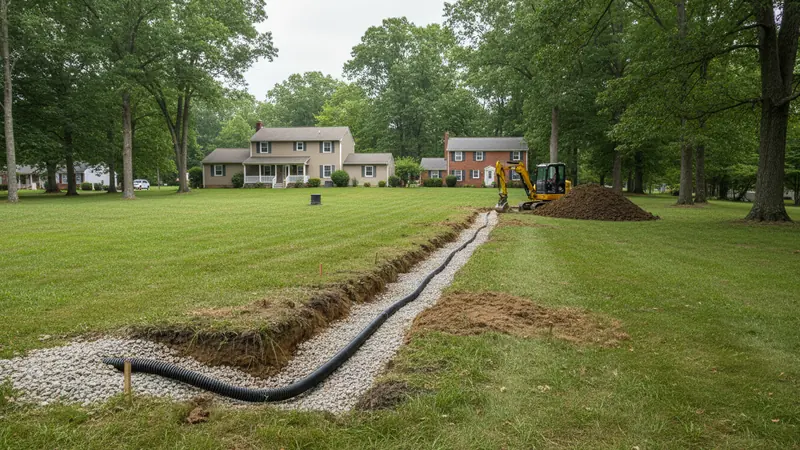
A $133 permit for a minor repair, $265 for a failing system, $288 to replace the tank — and a ceiling of around $50,000 if the answer is a new system.
What the county charges
| Work | Permit fee |
|---|---|
| Minor repair | $133 |
| Failing system repair | $265 |
| Septic tank replacement | $288 |
(Fee schedule revision 07-2024, read 21 September 2026.)
Two county documents disagree about the middle figure. The 07-2024 fee
schedule says a failing-system repair permit is $265. The Health
Department's own percolation requirements sheet, dated 15 December 2025,
says $295. Both are current county publications. Ask which applies and
get the answer in writing.
These are permit fees. They are not what the work costs, and the gap between them is large: repair in this county can reach upwards of $50,000 depending on what is actually wrong.
What makes a repair expensive
The tank is rarely the problem. A tank is a container and replacing one is bounded work at a known permit fee. What is unbounded is the drain field — and whether the lot has anywhere to put a new one.
Under COMAR 26.04.02.04, a lot approved after 18 November 1985 had to reserve room for the initial system plus two replacements, at 10,000 square feet per dwelling unit minimum. Older lots carry no such guarantee. A failing field on a lot with no reserve area is the case that runs into five figures, because the answer stops being a repair.
Ask early which category your lot is in. It is a matter of record and it changes what a quote can honestly promise.
The inspections you must book
Repair work carries the same two conditions printed on every Howard County septic permit:
- a pre-construction inspection before anything is dug
- an inspection and approval of all components before covering
Cover the work before it is approved and you will be uncovering it. Health Department-approved stone is required with the gravel ticket kept for review, tanks must be watertight, risers are required on tanks and pump chambers, and anything electrical needs its own separate permit.
The permittee is responsible for final approval, not the contractor. If your installer stops answering, the unapproved system is still yours.
Who may do the work
Since 31 December 2022, Maryland requires registration with the State Board of Onsite Wastewater Professionals for any activity associated with on-site disposal, repair included. Designers and installers are separately licensed under Environment Article Title 9, Subtitle 11A.
Every figure above carries its own source and the date it was read.