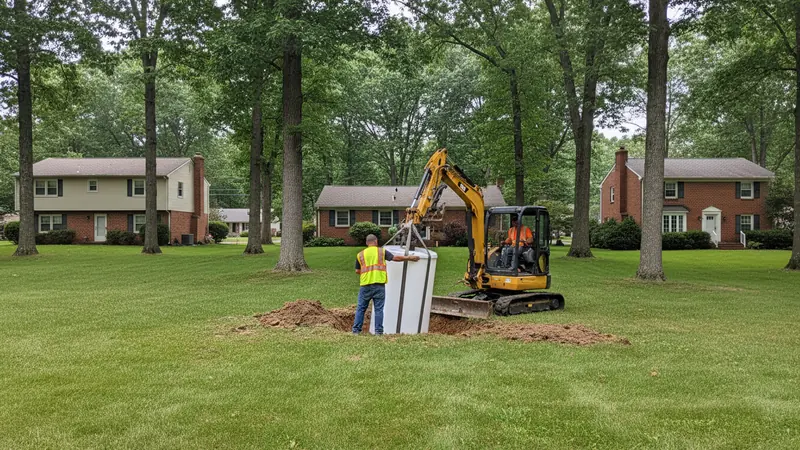
Permits, percolation tests, what the county actually charges, and what tends to go wrong with a septic system in a Howard County house.
We've dated every figure we gathered. If we know when a number expires, we've said so.
Who issues a septic permit here
Your septic permit comes from the Health Department's Bureau of Environmental Health, at 8930 Stanford Blvd, Columbia. Book inspections on 410-313-1771. The Department of Inspections, Licenses and Permits handles your building permit. If your property has a septic system, that permit waits for a Health Department review.
Your system's design must meet COMAR 26.04.02. It must also meet Howard County Code Title 3, Subtitle 8. Anyone designing or installing an on-site wastewater system in Maryland needs a licence from the Maryland State Board of Onsite Wastewater Professionals. This is required under Environment Article Title 9, Subtitle 11A. Check their licence before you let anybody dig.
What the county charges
The numbers behind this
| Work | Fee |
|---|---|
| New system, upgrade, or Bay Restoration Fund installation | $496 |
| Innovative or alternative system | $750 |
| Septic tank replacement | $288 |
| Failing system repair | $265 |
| Minor repair | $133 |
| Sewage scavenger permit (per truck, per site) | $155 |
Howard County Bureau of Environmental Health, fee schedule revision 07-2024, read 21 September 2026. The published amounts already include the 10% technology surcharge.
Commercial fees depend on how much sewage the system is designed to handle. You'll pay $496 up to 1,000 gallons a day. For 1,000–5,000, it's $703. Above that, it's $925.
(Fee schedule revision 07-2024, read 21 September 2026.)
A 10% technology surcharge applies to uncapped Bureau of Environmental Health fees. The published amounts already include it. State law caps the well permit fee. County code caps the shared-system installation fee.
Percolation testing
| Test | Fee |
|---|---|
| Failing system | $265 |
| Retest, existing lot of record | $551 |
| New subdivision lot | $595 |
| Plan review, 1–10 conventional lots | $46 per lot |
| Plan review, 11+ conventional lots | $54 per lot |
| Plan review, sand mound | $144 per lot |
Two county documents disagree. The 07-2024 fee schedule puts repair of a
failing system at $265. The Health Department's own percolation
requirements sheet dated 15 December 2025 puts it at $295. Both are
current county publications. Ask which applies before you budget. Get
the answer in writing.
- 1Tanks must be watertight and carry a manhole riser. Replacing one is permitted at $288 — the cheapest line on the schedule and the job most homeowners meet.
- 2The distribution box splits the flow between the trenches. Nothing may be covered until the Health Department has inspected and approved it — cover a system early and you will be uncovering it.
- 3On a lot approved after 18 November 1985, the disposal area must hold an initial system plus two full replacements: a minimum of 10,000 square feet per dwelling unit. On an older lot that area may simply not exist, which is the difference between a repair and a very expensive conversation.
- 4At least 100 feet between any part of the system and a water well. The water supply line itself must stay at least ten feet from the tank, the pump chamber, the sewage piping, the distribution box, the drain fields and the reserve.
Howard County Bureau of Environmental Health standing permit conditions; COMAR 26.04.02.04. Read 21 September 2026.
The two inspections nobody mentions
Your Howard County septic permit has conditions printed on it. Two cover inspections your contractor must book:
- Before you start. Your contractor must book a pre-construction inspection before any installation begins.
- Before you cover anything. Your contractor must book an inspection. Every component needs approval before you cover it.
If you cover a system before it is approved, you will have to uncover it. Use stone approved by the Health Department. Keep the gravel ticket for review. Your tanks must be watertight. Fit manhole risers on tanks and pump chambers. Keep at least 100 feet between any part of the system and a water well. Get a separate electrical permit for any electrical component.
One detail catches people: as the permittee, you're responsible for final approval, not the contractor. If your installer disappears, the unapproved system is still yours.
When a building permit turns into a septic project
Allow for a 10 business day Health Department review once your building permit application is forwarded. Provide scaled site plans showing the well, the septic, the house, the addition and the boundaries.
The county can hold your application until you get a percolation certification or testing. It can also hold it until you upgrade your septic system or well. It may hold it until you connect to public utilities. Common triggers include:
- an addition over 250 square feet
- one more bedroom
- more living space generally
- a garage or pool house
- an existing system found inadequate
What counts as a bedroom
The county defines a bedroom more broadly than an estate agent does. That's where additions can go wrong. Howard County Code § 3.801(b) sets the rules. A bedroom is any conditioned space of 90 square feet or more that could serve as a private sleeping area. It must also have at least one window and one interior door.
Your home office or library is exempt only if it has no closet. It must also meet one of four further conditions:
- built-in bookcases that get in the way of using the room
- a four-foot doorless opening to another room
- a half wall of four feet maximum
- a first-floor or basement location with no access to full or roughed-in bathroom plumbing
Call your new room an office if you like. If it has a closet, the county will call it a bedroom. Your septic system will need to be sized for it.
(Health Department memorandum to home builders, 25 March 2026.)
What is under Howard County houses
58.4% of the county's homes — 73,212 units — were built between 1970 and 1999. Only 12.2% predate 1970. That age shapes what fails. Many local systems are old enough for original tanks and drain fields to have reached or passed their typical service life. Most local systems are neither brand new nor long since replaced.
In the Rural West, the county's own general plan says soils "generally" support drain fields. New private community sewerage systems are no longer permitted there. Only publicly owned shared systems are allowed.
COMAR 26.04.02.04 sets the rules for lot sizes. Was your lot approved after 18 November 1985? Its sewage disposal area must fit an initial system plus two replacements. You need at least 10,000 square feet per dwelling unit. On an older lot, you may have no replacement area at all. That can turn a repair into a very expensive conversation.
We've included a source for every figure, with the date we read it.